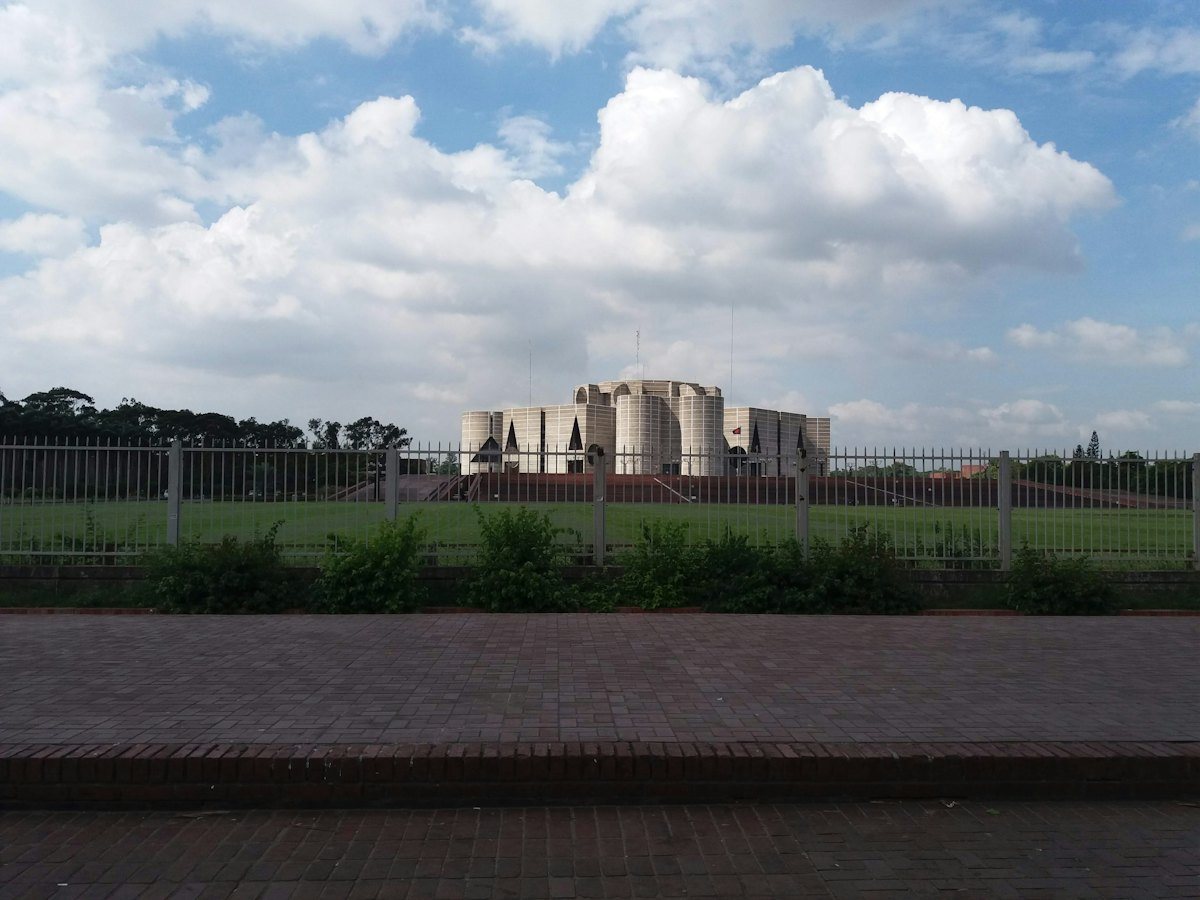
The Jatiya Sangsad Bhaban, Bangladesh’s National Parliament House, is one of the most celebrated buildings of the 20th century. It was designed by the American architect Louis I. Kahn, who received the commission in the early 1960s, when Dhaka was planned as a second capital of Pakistan.
Construction stopped during the Liberation War of 1971 and resumed after independence. Kahn died in 1974, before the work was done, and the building was completed under his associates. It was inaugurated in 1982 as the seat of the parliament of independent Bangladesh.
The building is a cluster of massive concrete forms cut with huge circles, triangles and rectangles that let light into the interior, with thin lines of white marble set into the concrete. It rises from an artificial lake, and the wide lawns, brick buildings and avenues around it are part of Kahn’s master plan for Sher-e-Bangla Nagar.