
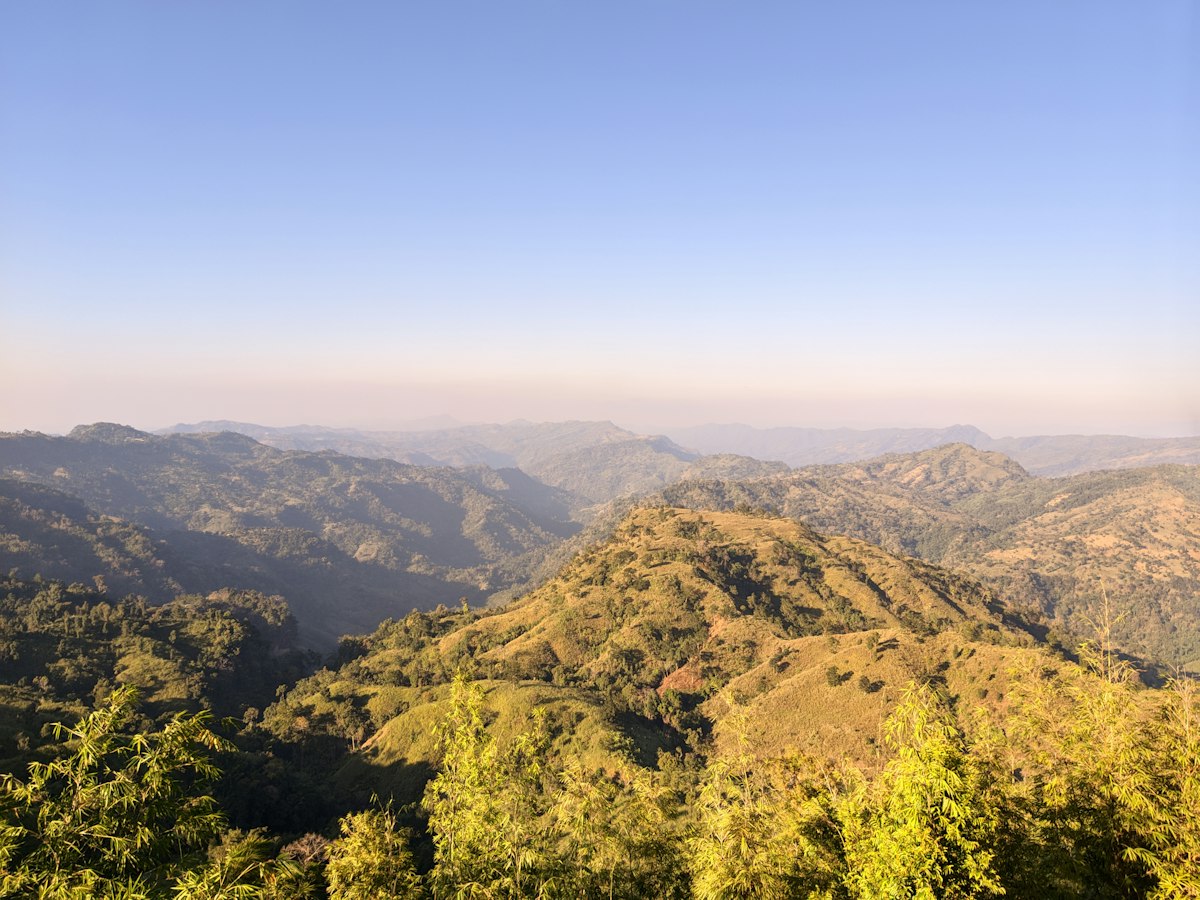
Bandarban, Chattogram
Bandarban
The highest hills in Bangladesh: the Sangu river, mountain roads above the clouds, Marma, Mro and Bawm villages, Boga Lake, Nafakhum and the golden Buddha Dhatu Jadi.
Local food to try
Where to eat
Where to stay
Culture
Bandarban’s many peoples keep their own languages, dress and festivals, and most Marma villages have a kyang (Buddhist monastery).
- Sangrai: the Marma New Year in mid-April, part of the hill peoples’ Boisabi season, is celebrated with the water festival — young people splash each other with water as a blessing — along with music, dance and rice cakes.
- Rajpunya: the Bohmong Raja’s traditional gathering, when the people of the circle come to the palace in Bandarban town, with a fair around it.
- Probarana Purnima: at the end of the rainy-season retreat, Buddhists light lamps and release paper lanterns (fanus) into the sky.
- Weaving: Marma and Bawm women weave on backstrap looms; shawls and cloth are sold in town.
- The Mro are known for their bamboo flute music and dances; their villages are deep in the hills.
History
Bandarban is the wildest of the three hill districts, with the country’s highest peaks — Keokradong, Tazing Dong and Saka Haphong among them — rising along its south-eastern border with Myanmar. The Sangu river runs through the district from the far hills down past Thanchi and Ruma to Bandarban town.
The town is the seat of the Bohmong Raja, head of the Bohmong Circle, one of the three traditional circles of the Hill Tracts. The Marma are the largest hill community here, and the district is also home to the Mro, Bawm, Tripura, Tanchangya, Khumi, Khyang, Chak, Lushai, Pangkhua, Chakma and others — more distinct peoples than almost anywhere else in the country.
For travellers, Bandarban means mountain roads and long walks: Nilgiri and Nilachal for views over the clouds, the golden Buddha Dhatu Jadi near town, and deeper in the hills Boga Lake, Keokradong and the waterfalls of Nafakhum. Much of the interior is remote and access depends on security conditions, so plans here need patience and a local guide.
Plan your visit
Best time to visit
October to February for dry trails and clear views. Waterfalls are fullest from July to October, but boats and treks are riskier then.
How to get there
- From Dhaka: direct buses run to Bandarban town, about 8–10 hours, mostly overnight, via Chattogram and Keranihat.
- From Chattogram: buses leave from the Bahaddarhat area, about 2.5–3 hours via Keranihat.
- From Cox’s Bazar, go up the highway to Keranihat and change for Bandarban.
- Carry your national ID card or passport for checkpoints on the hill roads.
Getting around
- Chander gari (open-backed jeeps) are hired in Bandarban town for Nilgiri, Thanchi and Ruma; the roads are steep and winding.
- CNG auto-rickshaws for the town and nearby spots like Meghla, Nilachal and Buddha Dhatu Jadi.
- Boats on the Sangu river from Thanchi to Remakri, and in places from Ruma.
- On foot with a registered local guide for Boga Lake, Keokradong and Nafakhum.